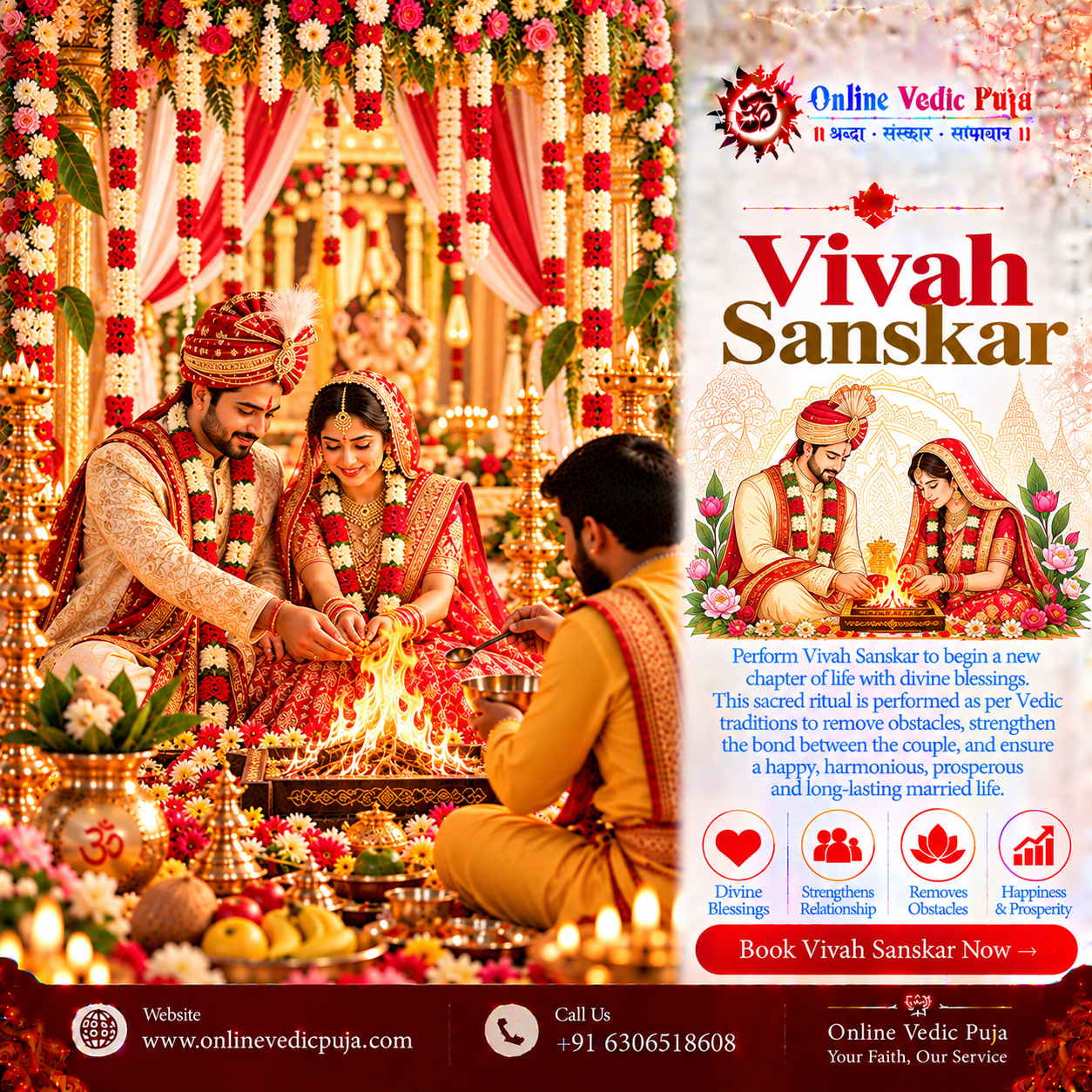
Vivah Sanskar is traditionally regarded as one of the important Sanskars in Hindu life. 🌺🙏 The word Vivah refers to marriage, while Sanskar represents a sacred process of refinement, responsibility, and meaningful transition. Through Vivah Sanskar, two individuals formally enter a new phase of life as partners and accept responsibilities toward each other, their families, and their shared household.
Unlike a simple social celebration, the traditional Vivah Sanskar contains several spiritual and symbolic rituals. Each ceremony has its own significance and may vary according to regional, family, community, and Vedic traditions.
The ceremony commonly begins with Ganesh Puja, followed by purification rituals and Sankalp. The priest establishes the sacred ritual environment and guides the families through the prescribed procedures. 🪔
Agni is given an important place in many Vivah Sanskar traditions. The sacred fire represents purity and serves as a witness to the commitments made by the couple. The bride and groom participate in various rituals and recite or listen to Vedic mantras according to the wedding tradition.
One of the central elements in many traditions is Saptapadi, in which the couple takes seven steps or makes seven associated commitments around the sacred fire. The exact interpretation and sequence of these steps can differ between traditions, but they are broadly connected with shared responsibilities, nourishment, strength, prosperity, family life, companionship, and spiritual values. 🔥💍
Other important rituals may include Kanyadan, Panigrahan, Mangal Pheras, Sindoor, Mangal Sutra, Ashirwad, and Aarti. Some communities may have additional rituals before or after these ceremonies.
Vivah Sanskar also represents the coming together of two families. Parents and elders participate in the ceremony, provide blessings, and support the couple as they begin their married life. The presence of family members adds an important emotional and cultural dimension to the wedding.
The couple may take blessings for mutual respect, trust, patience, communication, emotional support, health, prosperity, family harmony, and spiritual growth. 🌿🙏
The preparation for Vivah Sanskar may include arranging the Mandap, Havan Kund, puja materials, sacred water, flowers, fruits, sweets, grains, coconut, Kalash, Havan Samagri, and other traditional items.
The exact list of materials should be prepared according to the priest’s guidance because requirements differ according to the specific wedding tradition.
A well-organized Vivah Sanskar allows the couple and their families to participate meaningfully rather than simply following rituals mechanically. Understanding the significance of each step can make the ceremony more personal and memorable.
The ceremony can be arranged according to the family’s traditional customs while maintaining the essential elements prescribed by the chosen ritual tradition.
Vivah Sanskar is ultimately a celebration of partnership, responsibility, family, tradition, commitment, and spiritual values. It gives the bride and groom an opportunity to begin married life with blessings and a shared commitment toward building a harmonious household. ❤️✨
विवाह संस्कार विवरण
विवाह संस्कार हिंदू जीवन परंपरा में एक महत्वपूर्ण संस्कार माना जाता है। 🌺🙏 यह केवल विवाह समारोह नहीं बल्कि दो व्यक्तियों के जीवन में एक नई जिम्मेदारी और साझेदारी की शुरुआत का पवित्र माध्यम है।
विवाह संस्कार में विभिन्न वैदिक मंत्र, पूजा, अग्नि अनुष्ठान, संकल्प, आशीर्वाद और पारंपरिक रस्में शामिल होती हैं।
सामान्यतः गणेश पूजन के बाद शुद्धिकरण और संकल्प किया जाता है। इसके बाद निर्धारित देवी-देवताओं का पूजन और विवाह से संबंधित वैदिक विधियां शुरू होती हैं। 🪔
कई परंपराओं में अग्नि को विवाह संस्कार का महत्वपूर्ण हिस्सा माना जाता है। अग्नि के समक्ष वर-वधू विभिन्न संकल्प लेते हैं और वैवाहिक जीवन की जिम्मेदारियों को स्वीकार करते हैं।
सप्तपदी विवाह संस्कार की महत्वपूर्ण विधियों में से एक है। इसमें वर-वधू सात चरणों या सात संबंधित संकल्पों के माध्यम से अपने साझा जीवन की विभिन्न जिम्मेदारियों और मूल्यों को स्वीकार करते हैं। विभिन्न समुदायों में इनके अर्थ और विधि में अंतर हो सकता है। 🔥
कन्यादान, पाणिग्रहण, मंगल फेरे, सिंदूर, मंगलसूत्र, आशीर्वाद और आरती जैसी रस्में भी परिवार और क्षेत्र की परंपरा के अनुसार शामिल की जा सकती हैं।
विवाह संस्कार में माता-पिता, परिवार के बड़े और रिश्तेदार भी महत्वपूर्ण भूमिका निभाते हैं। वे नवविवाहित जोड़े को आशीर्वाद देते हैं और उनके सुखी जीवन की मंगलकामना करते हैं।
वर-वधू के लिए प्रेम, सम्मान, विश्वास, धैर्य, स्वास्थ्य, पारिवारिक सुख, समृद्धि और आध्यात्मिक विकास की प्रार्थना की जाती है।
विवाह संस्कार की सामग्री और विधि विवाह की परंपरा के अनुसार पहले से तैयार की जाती है। योग्य आचार्य या पंडित पूरी प्रक्रिया में परिवार का मार्गदर्शन करते हैं।
इस प्रकार Vivah Sanskar भारतीय विवाह परंपरा में संस्कार, परिवार, जिम्मेदारी, प्रेम, साझेदारी और आध्यात्मिक मूल्यों का सुंदर समन्वय है। 🙏✨
Reviews
There are no reviews yet.