
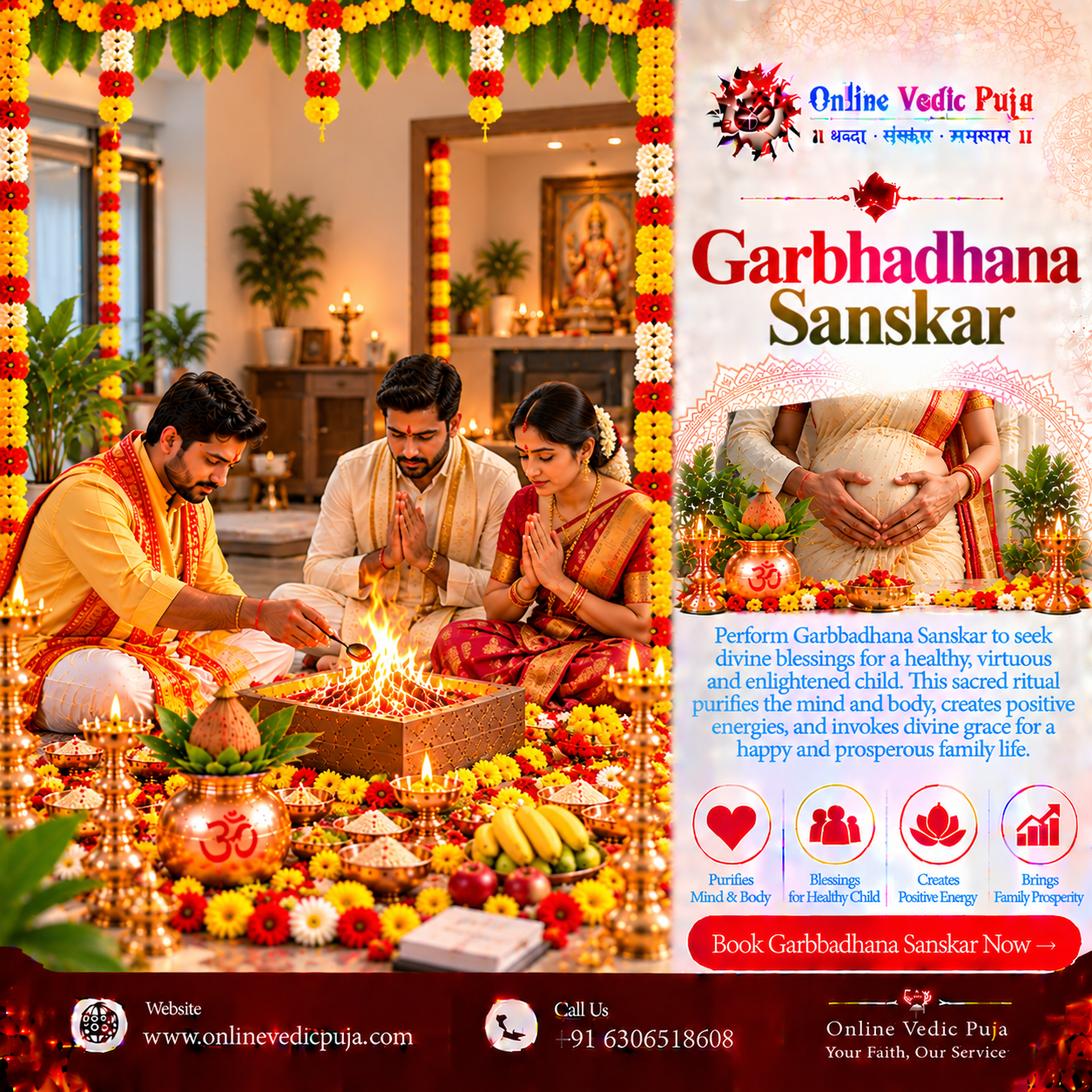


🪔 What Is Garbhadhana Sanskar?
Garbhadhana Sanskar is traditionally described in Hindu texts and customs as a Sanskar associated with conception and the beginning of the journey toward parenthood. It is counted among the sixteen traditional Hindu Sanskars in many commonly followed lists.
The ceremony reflects the belief that welcoming a child is an important responsibility that begins with thoughtful intentions, mutual understanding, and spiritual preparation. Families may perform this Sanskar to seek divine blessings for the couple, express their hopes for a healthy family life, and prepare emotionally and spiritually for parenthood.
The precise rituals, mantras, and timing vary according to family traditions, regional practices, and the guidance of the priest. The ceremony can be adapted to suit the couple’s preferences and may be conducted as a simple prayer ceremony or as a more elaborate Vedic ritual.
🙏 1. Lord Ganesha Puja
The ceremony may begin with the worship of Lord Ganesha, who is traditionally invoked before auspicious activities. The couple offers prayers for wisdom, understanding, and the ability to approach the responsibilities of family life with patience and care.
Flowers, Durva grass, incense, fruits, sweets, and a Diya may be offered according to the selected ritual. The priest recites appropriate Ganesh mantras and guides the couple through the opening prayers.
This part of the Sanskar symbolises beginning an important family journey with devotion, mutual respect, and thoughtful preparation.
🪷 2. Sankalp for Family Life
Sankalp is an important part of many Hindu ceremonies. During Garbhadhana Sanskar, the couple may express their intention to build a loving, supportive, and responsible family.
The Sankalp may include prayers for the couple’s well-being, mutual understanding, emotional stability, and readiness to care for a child. The ceremony can also be an opportunity to reflect on the values the couple hopes to nurture in their family, such as compassion, honesty, patience, and respect.
The Sankalp is a spiritual expression of intention rather than a guarantee of conception or any particular outcome.
🕉️ 3. Vedic Mantra Recitation
Vedic mantras may be recited during Garbhadhana Sanskar according to the selected tradition. The prayers commonly focus on family well-being, harmony, blessings, and the responsibilities associated with parenthood.
The priest selects appropriate mantras and explains the ceremony to the couple. Some families follow a specific regional or family tradition, while others prefer a simpler ceremony with general prayers.
The wording and sequence of mantras may differ between traditions, so the ritual should be arranged with a priest familiar with the family’s preferred customs.
🌺 4. Prayers for the Couple’s Well-Being
The ceremony may include prayers for the physical, emotional, and spiritual well-being of both partners. It recognises that preparing for parenthood is a shared journey that calls for understanding, communication, and mutual support.
The couple may offer flowers, light a Diya, and participate in prayers together. Family members may also join the ceremony if the couple wishes.
These prayers can provide a meaningful moment to discuss shared hopes and responsibilities while respecting the couple’s privacy and personal choices.
🏺 5. Kalash Sthapana
Some families include Kalash Sthapana as part of Garbhadhana Sanskar. A traditional Kalash may be prepared using clean water, mango leaves, a coconut, and other materials according to the priest’s instructions.
The Kalash is regarded in Hindu tradition as a symbol of auspiciousness and sacred intention. Prayers are offered for peace, harmony, and the well-being of the family.
Kalash Sthapana is optional and may be included according to regional customs and the selected form of the ceremony.
🔥 6. Havan for Auspicious Blessings
A Havan may be included when the family wishes to perform a more elaborate Vedic ceremony. The priest recites the selected mantras and offers appropriate Havan Samagri into the sacred fire.
The prayers may express gratitude and seek blessings for family harmony, responsible parenthood, and the well-being of the couple. The exact procedure depends on the tradition followed.
Havan should only be conducted in a well-ventilated, suitable location with proper fire-safety precautions. If the home or venue cannot safely accommodate a fire ritual, the Sanskar can be performed through prayers and other appropriate rituals without Havan.
🛕 7. Choosing an Auspicious Muhurat
Some Hindu families consult a priest to select an auspicious date or Muhurat for Garbhadhana Sanskar. The timing may depend on the family’s religious traditions, regional customs, and the type of ceremony planned.
The priest can explain the traditional considerations used by the family and help arrange a convenient time for the couple. Religious timing should not create unnecessary pressure or interfere with the couple’s comfort, consent, or personal circumstances.
There is no universally applicable religious date or ritual that guarantees conception or a particular pregnancy outcome.
🌼 8. Garbhadhana Sanskar Samagri
The required materials depend on the chosen rituals. Common items may include:
-
🪔 Diya, cotton wicks, and ghee or oil
-
🌺 Fresh flowers and garlands
-
🥥 Coconut, mango leaves, and Kalash
-
🍎 Fruits, sweets, and Panchamrit ingredients
-
🧴 Haldi, Kumkum, Chandan, Akshat, and clean water
-
🕯️ Incense sticks and camphor, where permitted
-
📖 Puja book, selected mantras, and priest-recommended items
-
🔥 Havan Kund and Havan Samagri, if Havan is included
The priest should confirm the final list in advance. Families may choose a simpler arrangement if they prefer a short and private ceremony.
👩❤️👨 9. Participation of the Couple
The couple is at the centre of Garbhadhana Sanskar. Both partners should have the opportunity to understand the ceremony, discuss their preferences, and participate willingly.
They may offer flowers, join the prayers, take the Sankalp, and receive blessings from elders if desired. Family participation should be based on the couple’s comfort and wishes.
The ceremony should be conducted with dignity, privacy, and mutual consent. It is a spiritual observance and should never be used to pressure either partner regarding conception, intimacy, or the timing of parenthood.
👪 10. Blessings from Elders
In some families, elders offer blessings to the couple during or after the Sanskar. Their prayers may express hopes for a loving household, mutual respect, and a supportive family environment.
The couple may seek guidance from trusted family members while making their own decisions about parenthood. Traditions differ, and elder participation is optional rather than compulsory.
🙌 11. Aarti and Prasad
The ceremony may conclude with Aarti and prayers for the well-being of the couple and their family. Prasad is distributed according to the family’s customs.
The couple may spend time reflecting on the meaning of the Sanskar and the shared responsibilities associated with preparing for parenthood. Some families keep the observance intimate, while others invite close relatives.
✨ 12. Spiritual Significance of Garbhadhana Sanskar
Garbhadhana Sanskar represents a traditional Hindu approach to preparing for parenthood through prayer, intention, and a sense of responsibility. It places importance on family harmony, mutual respect, and the emotional and spiritual readiness of both partners.
The ceremony is a religious and cultural observance. It cannot guarantee conception, fertility, the health of a future child, or a particular pregnancy outcome. For questions about fertility, conception timing, or reproductive health, qualified healthcare professionals can provide appropriate medical guidance.
📿 Arrange Garbhadhana Sanskar with Vedic Puja
Vedic Puja helps families arrange Garbhadhana Sanskar according to their religious customs and personal preferences. The ceremony may include Ganesh Puja, Sankalp, Vedic mantra recitation, Kalash Sthapana, blessings for the couple, and Havan where suitable.
Whether you prefer a simple prayer ceremony at home or a more elaborate Vedic ritual, the arrangements can be adapted to respect the couple’s comfort, privacy, and traditions.
Vedic Puja — श्रद्धा • संस्कार • समाधान
गर्भाधान संस्कार विवरण
🪔 गर्भाधान संस्कार क्या है?
गर्भाधान संस्कार हिंदू परंपरा में वर्णित एक महत्वपूर्ण संस्कार है, जिसका संबंध संतान की कामना, परिवार की शुरुआत और माता-पिता बनने की जिम्मेदारी के लिए आध्यात्मिक तैयारी से है। कई प्रचलित सूचियों में इसे सोलह संस्कारों में पहला संस्कार माना जाता है।
इस संस्कार के माध्यम से दंपति अपने पारिवारिक जीवन की नई यात्रा के लिए ईश्वर से आशीर्वाद मांगते हैं। यह परंपरा इस विचार को महत्व देती है कि परिवार की शुरुआत प्रेम, आपसी समझ, जिम्मेदारी और सकारात्मक संकल्प के साथ होनी चाहिए।
गर्भाधान संस्कार की विधि, मंत्र, समय और परंपराएं अलग-अलग परिवारों तथा क्षेत्रों में भिन्न हो सकती हैं। इसे पुरोहित के मार्गदर्शन में साधारण पूजा या विस्तृत वैदिक अनुष्ठान के रूप में आयोजित किया जा सकता है।
🙏 1. भगवान गणेश की पूजा
गर्भाधान संस्कार की शुरुआत भगवान गणेश के पूजन से की जा सकती है। हिंदू परंपरा में भगवान गणेश को शुभ कार्यों के आरंभ में स्मरण किया जाता है। इस पूजा के माध्यम से दंपति बुद्धि, विवेक, आपसी समझ और पारिवारिक जिम्मेदारियों को धैर्य के साथ निभाने के लिए प्रार्थना करते हैं।
पूजा में फूल, दूर्वा, धूप, फल, मिठाई और दीपक अर्पित किए जा सकते हैं। पुरोहित गणेश मंत्रों का उच्चारण करते हैं और दंपति को प्रारंभिक पूजा की विधि बताते हैं।
यह अनुष्ठान परिवार की नई यात्रा को श्रद्धा, आपसी सम्मान और उचित तैयारी के साथ शुरू करने का प्रतीक है।
2. पारिवारिक जीवन के लिए संकल्प
संकल्प कई हिंदू धार्मिक अनुष्ठानों का महत्वपूर्ण हिस्सा होता है। गर्भाधान संस्कार में दंपति प्रेमपूर्ण, सहयोगी और जिम्मेदार पारिवारिक जीवन के निर्माण का संकल्प ले सकते हैं।
इस संकल्प में दोनों के कल्याण, आपसी समझ, भावनात्मक संतुलन और भविष्य में बच्चे की देखभाल की जिम्मेदारी के लिए प्रार्थना शामिल हो सकती है। दंपति उन मूल्यों पर भी विचार कर सकते हैं जिन्हें वे अपने परिवार में विकसित करना चाहते हैं, जैसे करुणा, ईमानदारी, धैर्य और सम्मान।
संकल्प एक आध्यात्मिक भावना और उद्देश्य की अभिव्यक्ति है। इससे गर्भधारण या किसी विशेष परिणाम की गारंटी नहीं होती।
🕉️ 3. वैदिक मंत्रों का जाप
गर्भाधान संस्कार के दौरान चुनी गई परंपरा के अनुसार वैदिक मंत्रों का उच्चारण किया जा सकता है। इन प्रार्थनाओं में परिवार के कल्याण, आपसी सामंजस्य, शुभकामनाओं और माता-पिता बनने की जिम्मेदारियों पर ध्यान दिया जाता है।
पुरोहित उपयुक्त मंत्रों का चयन करते हैं और दंपति को अनुष्ठान की प्रक्रिया समझाते हैं। कुछ परिवार अपनी पारिवारिक या क्षेत्रीय परंपरा के अनुसार विशेष मंत्रों का पालन करते हैं, जबकि अन्य साधारण प्रार्थना के साथ संस्कार करना पसंद करते हैं।
मंत्रों का क्रम और विधि अलग-अलग परंपराओं में भिन्न हो सकती है, इसलिए पूजा परिवार की पसंद और पुरोहित के मार्गदर्शन के अनुसार आयोजित की जानी चाहिए।
🌺 4. दंपति के कल्याण के लिए प्रार्थना
इस संस्कार में पति-पत्नी दोनों के शारीरिक, भावनात्मक और आध्यात्मिक कल्याण के लिए प्रार्थना की जा सकती है। माता-पिता बनने की तैयारी एक साझा यात्रा है, जिसमें आपसी समझ, संवाद और सहयोग का महत्वपूर्ण स्थान है।
दंपति साथ में पुष्प अर्पित कर सकते हैं, दीपक जला सकते हैं और प्रार्थना में भाग ले सकते हैं। यदि दंपति चाहें, तो परिवार के सदस्य भी इस अवसर पर शामिल हो सकते हैं।
यह पूजा दोनों को अपनी आशाओं, जिम्मेदारियों और भविष्य की योजनाओं पर शांतिपूर्वक विचार करने का अवसर देती है।
🏺 5. कलश स्थापना
कुछ परिवार गर्भाधान संस्कार में कलश स्थापना भी शामिल करते हैं। इसके लिए स्वच्छ जल, आम के पत्ते, नारियल और अन्य पारंपरिक सामग्री का उपयोग किया जा सकता है।
हिंदू परंपरा में कलश को शुभता और पवित्र संकल्प का प्रतीक माना जाता है। इसके माध्यम से परिवार में शांति, सामंजस्य और सभी सदस्यों के कल्याण के लिए प्रार्थना की जाती है।
कलश स्थापना वैकल्पिक है और इसे क्षेत्रीय परंपरा तथा चुनी गई पूजा विधि के अनुसार शामिल किया जा सकता है।
🔥 6. शुभ आशीर्वाद के लिए हवन
यदि परिवार विस्तृत वैदिक अनुष्ठान करना चाहता है, तो गर्भाधान संस्कार में हवन भी शामिल किया जा सकता है। पुरोहित निर्धारित मंत्रों का उच्चारण करते हैं और हवन सामग्री को पवित्र अग्नि में अर्पित करते हैं।
इस दौरान परिवार की शांति, जिम्मेदार माता-पिता बनने और दंपति के कल्याण के लिए प्रार्थना की जा सकती है। हवन की विधि परिवार की परंपरा और चुने गए अनुष्ठान पर निर्भर करती है।
हवन केवल उचित वेंटिलेशन और अग्नि-सुरक्षा की व्यवस्था वाले स्थान पर किया जाना चाहिए। यदि घर या पूजा स्थल पर अग्नि अनुष्ठान सुरक्षित न हो, तो बिना हवन के भी उपयुक्त धार्मिक विधियों से संस्कार किया जा सकता है।
🛕 7. शुभ मुहूर्त का चयन
कुछ हिंदू परिवार गर्भाधान संस्कार के लिए हिंदू पंचांग के अनुसार शुभ मुहूर्त चुनने हेतु पुरोहित से सलाह लेते हैं। समय का चयन परिवार की धार्मिक परंपरा, क्षेत्रीय रीति-रिवाज और पूजा के प्रकार के अनुसार किया जा सकता है।
पुरोहित परिवार को पारंपरिक मान्यताओं के बारे में जानकारी देकर सुविधाजनक समय निर्धारित करने में सहायता कर सकते हैं। धार्मिक समय-निर्धारण के कारण दंपति पर अनावश्यक दबाव नहीं पड़ना चाहिए और उनकी सुविधा, सहमति तथा व्यक्तिगत परिस्थितियों का सम्मान किया जाना चाहिए।
कोई भी धार्मिक तिथि या अनुष्ठान गर्भधारण या गर्भावस्था के किसी विशेष परिणाम की गारंटी नहीं देता।
🌼 8. गर्भाधान संस्कार की सामग्री
पूजा में आवश्यक सामग्री चुनी गई विधि के अनुसार अलग हो सकती है। सामान्य रूप से निम्नलिखित सामग्री की आवश्यकता हो सकती है:
-
🪔 दीपक, रुई की बत्ती और घी या तेल
-
🌺 ताजे फूल और माला
-
🥥 नारियल, आम के पत्ते और कलश
-
🍎 फल, मिठाई और पंचामृत की सामग्री
-
🧴 हल्दी, कुमकुम, चंदन, अक्षत और स्वच्छ जल
-
🕯️ धूपबत्ती और कपूर, जहां इनका उपयोग अनुमत हो
-
📖 पूजा पुस्तक, चुने गए मंत्र और पुरोहित द्वारा बताई गई सामग्री
-
🔥 हवन शामिल होने पर हवन कुंड और हवन सामग्री
पूजा से पहले पुरोहित से सामग्री की अंतिम सूची की पुष्टि कर लेना उचित है। परिवार चाहे तो कम सामग्री के साथ एक सरल और निजी पूजा भी आयोजित कर सकता है।
👩❤️👨 9. दंपति की सहभागिता
गर्भाधान संस्कार में पति-पत्नी दोनों की सहभागिता महत्वपूर्ण है। दोनों को पूजा की विधि समझने, अपनी पसंद साझा करने और अपनी इच्छा से अनुष्ठान में भाग लेने का अवसर मिलना चाहिए।
दंपति पुष्प अर्पित कर सकते हैं, मंत्रों के समय प्रार्थना कर सकते हैं, संकल्प ले सकते हैं और इच्छानुसार परिवार के बड़ों से आशीर्वाद प्राप्त कर सकते हैं।
यह संस्कार गरिमा, निजता और आपसी सहमति के साथ आयोजित किया जाना चाहिए। इसका उपयोग किसी भी साथी पर गर्भधारण, शारीरिक संबंध या माता-पिता बनने के समय को लेकर दबाव डालने के लिए नहीं किया जाना चाहिए।
👪 10. परिवार के बड़ों का आशीर्वाद
कुछ परिवारों में गर्भाधान संस्कार के दौरान या उसके बाद परिवार के बड़े दंपति को आशीर्वाद देते हैं। उनकी प्रार्थनाओं में प्रेमपूर्ण पारिवारिक जीवन, आपसी सम्मान और सहयोगी वातावरण की कामना शामिल हो सकती है।
दंपति चाहें तो परिवार के विश्वसनीय सदस्यों से मार्गदर्शन प्राप्त कर सकते हैं, लेकिन माता-पिता बनने से जुड़े निर्णय उनकी अपनी परिस्थितियों और इच्छाओं के अनुसार होने चाहिए। परिवार के बड़ों की सहभागिता वैकल्पिक है, अनिवार्य नहीं।
🙌 11. आरती और प्रसाद वितरण
संस्कार का समापन आरती और दंपति तथा परिवार के कल्याण की प्रार्थना के साथ किया जा सकता है। परिवार की परंपरा के अनुसार उपस्थित लोगों में प्रसाद वितरित किया जाता है।
इसके बाद दंपति इस संस्कार के महत्व और माता-पिता बनने की साझा जिम्मेदारियों पर विचार कर सकते हैं। कुछ परिवार इस पूजा को निजी रखते हैं, जबकि अन्य इसमें करीबी रिश्तेदारों को आमंत्रित करते हैं।
✨ गर्भाधान संस्कार का महत्व
गर्भाधान संस्कार माता-पिता बनने की तैयारी को श्रद्धा, संकल्प और जिम्मेदारी से जोड़ने वाली पारंपरिक हिंदू विधि है। इसमें पारिवारिक सामंजस्य, आपसी सम्मान और दोनों साथियों की भावनात्मक तथा आध्यात्मिक तैयारी को महत्व दिया जाता है।
यह एक धार्मिक और सांस्कृतिक अनुष्ठान है। इससे गर्भधारण, प्रजनन क्षमता, भविष्य में बच्चे के स्वास्थ्य या गर्भावस्था के किसी विशेष परिणाम की गारंटी नहीं होती। गर्भधारण, सही समय या प्रजनन स्वास्थ्य से संबंधित प्रश्नों के लिए योग्य स्वास्थ्य विशेषज्ञ से सलाह लेना उचित है।
📿 Vedic Puja के साथ गर्भाधान संस्कार
Vedic Puja के माध्यम से आप अपनी धार्मिक परंपराओं और व्यक्तिगत प्राथमिकताओं के अनुसार गर्भाधान संस्कार की व्यवस्था कर सकते हैं। इसमें गणेश पूजा, संकल्प, वैदिक मंत्रों का जाप, कलश स्थापना, दंपति के कल्याण के लिए प्रार्थना और उपयुक्त होने पर हवन शामिल किया जा सकता है।
चाहे आप घर पर साधारण पूजा कराना चाहते हों या विस्तृत वैदिक अनुष्ठान, इसकी व्यवस्था दंपति की सुविधा, निजता और पारिवारिक परंपराओं का सम्मान करते हुए की जा सकती है।
Vedic Puja — श्रद्धा • संस्कार • समाधान


Reviews
There are no reviews yet.